Dr. David Mathie
Trombonist, Professor, Arranger
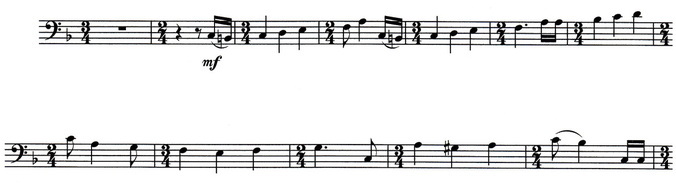
Grieg - Huldigungsmarsch (Homage March)
Twelve-part Brass Ensemble (3 Trumpets, 4 Horns, 3 Trombones, Euphonium, Tuba) and Percussion (3 players: Timpani, SD, BD, Cym., Triangle)
Difficulty Level: College through Professional
1. Highest note in trumpet 1 is written C; highest note in the trombones/euphonium/tuba is Bb
2. A bass trombone is required for the third trombone part
3. Percussion parts are important to the music but optional in a pinch
Published by Cherry Classics
Grieg - Huldigungsmarsch (Homage March)
Twelve-part Brass Ensemble (3 Trumpets, 4 Horns, 3 Trombones, Euphonium, Tuba) and Percussion (3 players: Timpani, SD, BD, Cym., Triangle)
Difficulty Level: College through Professional
1. Highest note in trumpet 1 is written C; highest note in the trombones/euphonium/tuba is Bb
2. A bass trombone is required for the third trombone part
3. Percussion parts are important to the music but optional in a pinch
Published by Cherry Classics
ABOUT THE MUSIC
Like many of his fellow Romantic composers, Norwegian composer Edvard Grieg (1843–1907) was a passionate nationalist. He befriended several of Norway’s artists and playwrights, in particular Bjørnstjerne Bjørnson, whom he met in 1870 (Bjørnson went on to become Norway’s national poet and winner of the 1903 Nobel Prize for literature). In 1872 the two collaborated on the historical play Sigurd Jorsalfar, with Grieg providing incidental music, much the same as he would do later with Ibsen’s Peer Gynt. The music consisted of nine parts and included four with voices and five purely orchestral. In 1892 Grieg published a suite using three orchestral movements from the original; the last movement was the Huldigungsmarsch, or Homage March, and is the basis for this transcription.
The original orchestral version had five percussion – timpani, snare drum, triangle, cymbals and bass drum, to be played by four percussionists. As these are not critical to the music I have made them optional, but they do add zest to the piece. If you need to choose, I would suggest adding them in this order: timpani, snare drum, cymbals/triangle, bass drum.
Like many of his fellow Romantic composers, Norwegian composer Edvard Grieg (1843–1907) was a passionate nationalist. He befriended several of Norway’s artists and playwrights, in particular Bjørnstjerne Bjørnson, whom he met in 1870 (Bjørnson went on to become Norway’s national poet and winner of the 1903 Nobel Prize for literature). In 1872 the two collaborated on the historical play Sigurd Jorsalfar, with Grieg providing incidental music, much the same as he would do later with Ibsen’s Peer Gynt. The music consisted of nine parts and included four with voices and five purely orchestral. In 1892 Grieg published a suite using three orchestral movements from the original; the last movement was the Huldigungsmarsch, or Homage March, and is the basis for this transcription.
The original orchestral version had five percussion – timpani, snare drum, triangle, cymbals and bass drum, to be played by four percussionists. As these are not critical to the music I have made them optional, but they do add zest to the piece. If you need to choose, I would suggest adding them in this order: timpani, snare drum, cymbals/triangle, bass drum.