Dr. David Mathie
Trombonist, Professor, Arranger
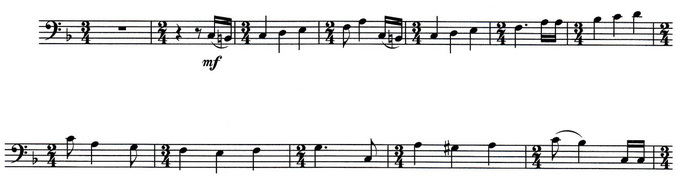
Rossini - 5 Duos
(in three versions: bass, tenor and alto clefs)
1. Marcia
2. Menuett
3. Adagio non troppo
4. Menutto
5. Allegro molto
Trombone Duet
Difficulty Level: High School/College
1. Bass clef version suitable for good high school players
2. Tenor and alto clef versions for more advanced players
3. Trombone 1 up to high F; trombone 2 down to low F (no F attachment required)
Published by Cherry Classics, catalog number CC3379
Click below to hear Duet 1
Click below to hear Duet 2
Click below to hear Duet 3
Click below to hear Duet 4
Click here to hear Duet 5
ABOUT THE MUSIC
5 Duos in 3 Clefs for Trombones
Gioachino Rossini was an Italian composer, born in 1792 and died in 1868. He was known
primarily for his thirty-nine operas, although he did compose some chamber pieces and a few
orchestral works. His 5 Duos for 2 Horns in E♭ were probably written in 1806 when Rossini was
fourteen and living in Bologna, although they weren’t published until 1861. While it may seem
unusual for a fourteen-year-old to be composing, by then Rossini had already written his String
Sonatas at the age of twelve, and those works are still performed today. An explanation for why
Rossini would write a set of duets for horn may be that his father was a professional trumpet
player, and taught his son Gioachino to play the horn at a very young age.
These five pieces were written for the natural (valveless) horns of the time, and like the horn
writing of Mozart some very technical passages can be found in the lower part, especially in
duets four and five. We can also hear the future opera composer’s arias in number three. The
duos will work quite well on recitals and also for casual duet playing. Because trombonists can
never have enough practice in clefs, I have transcribed the duets into three versions each using
bass, tenor and alto clefs.
David Mathie
September 2023
5 Duos in 3 Clefs for Trombones
Gioachino Rossini was an Italian composer, born in 1792 and died in 1868. He was known
primarily for his thirty-nine operas, although he did compose some chamber pieces and a few
orchestral works. His 5 Duos for 2 Horns in E♭ were probably written in 1806 when Rossini was
fourteen and living in Bologna, although they weren’t published until 1861. While it may seem
unusual for a fourteen-year-old to be composing, by then Rossini had already written his String
Sonatas at the age of twelve, and those works are still performed today. An explanation for why
Rossini would write a set of duets for horn may be that his father was a professional trumpet
player, and taught his son Gioachino to play the horn at a very young age.
These five pieces were written for the natural (valveless) horns of the time, and like the horn
writing of Mozart some very technical passages can be found in the lower part, especially in
duets four and five. We can also hear the future opera composer’s arias in number three. The
duos will work quite well on recitals and also for casual duet playing. Because trombonists can
never have enough practice in clefs, I have transcribed the duets into three versions each using
bass, tenor and alto clefs.
David Mathie
September 2023